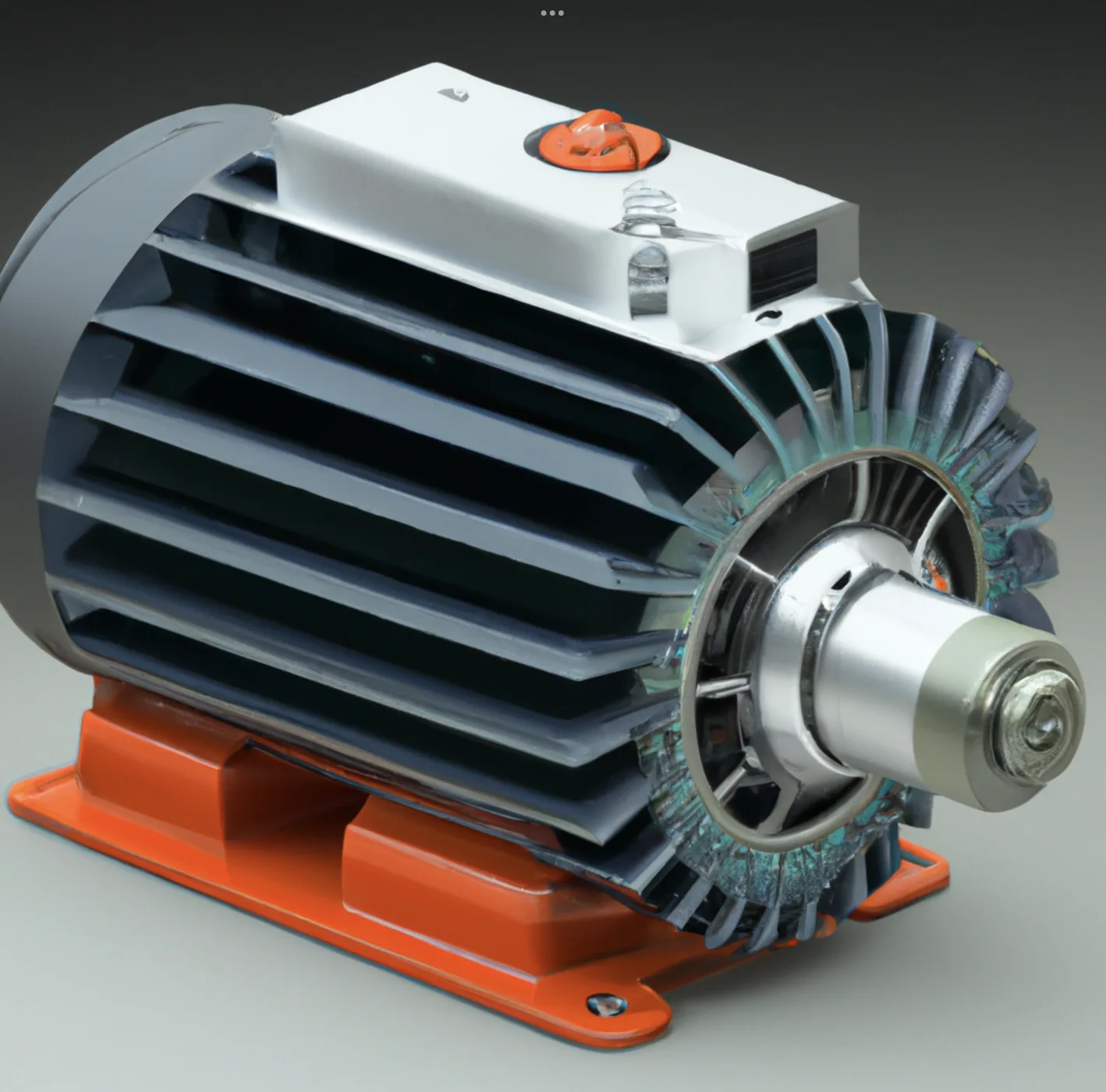
Why Induction Machines are the work horse for AC systems.
Electric Motors - Induction Machines
Induction machines, also known as asynchronous motors, are a popular choice for ac motors in industry due to their reliability, efficiency and low cost of ownership. The rotor in an induction motor is made of a conductor material such as copper or aluminum, and it rotates inside a stator that contains a set of stationary coils. The stator generates a rotating magnetic field, which induces an electrical current in the rotor. This current in turn creates its own magnetic field, which interacts with the stator field to produce torque and cause the rotor to rotate.
One of the key advantages of induction machines is that the rotor does not need a commutator, which simplifies the design and reduces the need for maintenance. Commutators and brushes are wear parts that can wear out over time, causing sparks, arcing, and commutation failures. These issues can lead to poor performance, reduced efficiency, and increased maintenance costs. Without a commutator, the rotor can run smoother and more efficiently than other types of motors.
Since the introduction of power electronics and control theory, the control of induction machines has become much easier. Power electronics refers to the use of electronic devices, such as semiconductors, to control and convert electrical power. These devices can be used to control the speed, torque, and other parameters of an induction motor, making it more versatile and adaptable to different applications. One of the key advantages of using power electronics is that they can be used to change the frequency of the power supplied to the motor, which in turn changes the speed of the motor. This is known as variable frequency drive (vfd) technology. By adjusting the frequency, the speed of the motor can be precisely controlled, regardless of the load or the application.
Australian standards such as AS/NZS60034.2.1-2010 for rotating electrical machines, which are used to certify the efficiency of electric motors, also support the use of induction machines in industry. The standard equation for induction machines is given by:
T= (3/2) * P * (1 - s)/ω
where t is the torque, p is the number of poles, s is the slip, and ω is the angular velocity of the rotor.
The equation for controlling the speed of an induction machine is given by:
ω = (1-s)*ω_s
where is the angular velocity of the rotor, s is the slip, and ω_s is the synchronous angular velocity.
In conclusion, induction machines are the powerhouses for ac motors in industry due to their reliability, efficiency, low cost of ownership, and the absence of commutator. The introduction of power electronics and control theory has made controlling them much easier and precise, and their use is supported by Australian Standards.
